|
|
*** NOTES: OCTOBER WALNUT HARVEST AT HAAG FARM ***
As a knowledgeable and interested
individual, we wanted to update you about the correct timing of English walnut harvest, whose history covers thousands of
years. This approach is called: "The more you know, the more you value." Thus, the estimated time of harvest
for www.Walnuts.US is usually in early October when the 2,000 walnuts hanging throughout the volume of each of our quarter-century
old orchard trees meet three vital and independent conditions listed below. However, take our word that the occurrence of
these conditions is unfortunately not simultaneous nor is it entirely predictable. Over the past 25+ years, we have seen
many and inconsistent variations on this theme. The three essential conditions for the walnuts harvestability are:
1) Nuts must be fully ripe with 100% full-spectrum, non-green mature taste;
2) 99% of the nuts are capable of
being shaken from the walnut tree on one 15-second attempt without damage from or to the tree; and
3) 98% of these
fallen nuts can be hulled without cracking the shells and with no remnants of green hull remaining. (We use the other 2%
as compost.)
Some years, the nuts are shakable but not hullable. Other years, the walnuts just won't release
from the tree until later in October when heavier dews occur. That is, the reverse of the former condition occurs, they are
hullable, but not shakable. We must then wait until we judge you will receive a top quality product: fully mature flavors,
100% non-broken shells for inshell orders/100% clean walnut halves/pieces for shelled orders, and minor contamination.
If one rushes walnut harvest or otherwise interferes unwisely with Mother Nature, many "bad" things
can happen to the product. Here is an alphabetic list describing the undesirable tastes of walnuts. This is based mostly
on what our customers have complained about concerning competitors' non-Haag Farm walnuts over the years:
acid,blah,cold,deadly,ecoli,fibrous,grassy,hard,immature,junky,kinky,light,musty,nasty,
oily,putrid,queer,rancid,salmonella,tasteless,unknown,varied,woody,xtra,yucky,zzpplt...
Moving onwards on
harvest timing, we use numerous methods, e.g., dust control, water withdrawal, and ripening control (Remember using a ripe
banana to hasten the ripening of non-mature fruit in a bag?), in attempting to make the three above conditions coincide.
Meanwhile, avoiding the 26 undesirable tastes & states listed above. It can be a frustrating experience...
If nature sends along a light rain in the middle of September, ending our many months of rainless summer days in California's
semi-arid 400-mile long Central Valley, this has a more desirable effect than almost anything we growers can do. Heavy dews
help as we need those thick dry green hulls to begin to split right there on the tree. Only then, can we start harvest operations...
Next, we use special testing techniques to select the exact day to begin. Some of these techniques are trade
secrets, but one we can reveal is to drive a pocket knife 1" into a walnut at the attachment end, give a 90-degree twist,
and see what happens. Two perfect halves inside the shell with a fractured hull outside that automatically falls off comprise
an excellent sign that the desired harvest day is within a week. Finally, we use special harvesting techniques when all is
ready!
One example would be to vary the time of tree shaking which we can change from, say, 15 seconds to
only 7 seconds to bring down all 2,000 nuts. Or give a double shake of 7 seconds each time. Another example is the pattern
followed by the gripping end of the $250,000 hydraulic shaker; we can perhaps use a 4-leaf clover pattern rather than a 5-pointed
star shaking pattern. And this goes on and on...for after all a grower is paid only once a year, following harvest, so we
have 365 days, and nights, to plan for it.
Finally, the days of harvest arrive and we have already ended
all irrigation and mechanically scraped almost all vegetation off the harvest floor so there is very clean dry level soil
under all the walnut trees. To some eyes, the orchard resembles a big clay tennis court with trees. Next, the shaker shakes
down a quarter-mile pair of rows of trees, doing one on the left, then one on the right, backing up then to the next pair
of trees, etc.
Now, the 8'-wide sweeper can blow the 2,000 nuts per tree away from the trunks and sweep
them all into a quarter-mile long windrow down the middle of each pair of tree rows. When this is completed, a huge vacuum-cleaner
type of machine, called a pickup machine, drives over the walnut windrows, sucks them up while blowing out any debris, and
dumps them into an attached cart. The carts when full are emptied into large open-bed trucks which take the walnuts to the
huller for water-bath cleaning, hulling, and then drying to the optimal 8% moisture. Finally, these clean babied English
walnuts are gently cooled to room temperature, eyeballed so any rejects can be taken out, boxed, and then rapidly posted to
your home address...
|
|
|
|
|
|
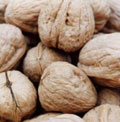
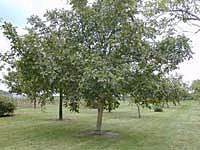
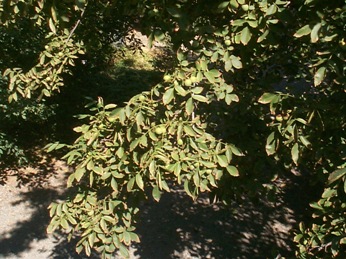
About 2,000 walnuts for each mature
tree... English
Walnut Harvest & Processing
James N. Haag © 2013
A typical mature walnut tree holds over
1,000 walnuts at the normal time of harvest each year in late September, often early October. The orchard
floor in this period has been rendered free of most vegetation and debris and is basically just smooth brown soil.
Harvest begins when the walnuts are almost all ripe with the walnuts 90% shakeable (capable of readily
being shaken off the tree via a drivable machine called a shaker) and maybe 95% hullable (capable of readily
having the greenish semi-dried hull scraped off the hard brown walnut shell by a big stationary machine called a huller, described
later below). The three above conditions seldom occur at the same time. Thus, one tries
to choose a reasonable compromise time to start harvest.
What happens on the chosen day of harvest? The six typical operations are described below.
First, a large-armed hydraulically-driven shaker grabs the trunk of the walnut tree and shakes it for about 15 seconds
in such a pattern that about 90% of the 2,000 walnuts fall to the ground, along with some sticks and leaves. Secondly,
after each tree row is shaken at a rate of perhaps two trees per minute, the powered walnut sweeper is driven down each row
at about 4 mph or so, blowing and raking all the fallen walnuts into a long uniform pile of product, called a windrow, down
the center of each orchard middle. Due to the significant air movements involved, this is a very dusty
operation. Next, for some orchards, a “stick
picker” is driven rapidly down each row, separating the fallen sticks from the walnuts in the windrow and moving them
into its built-in bin, leaving a cleaner windrow comprised mostly of walnuts, little sticks and leaves. Fourth,
a crew of workers carrying light rakes walks down each orchard row, flicking stray walnuts (such as ones caught in soil cracks
or lying next to tree trunks) into the neat windrow. Finally, a large “vacuum cleaner” device,
called the harvester, moves down each row, sucking up close to 100% of all the walnuts and automatically moving them into
a towed wheeled metal bin, holding a ton or so of harvester results. This bin, when full, is quickly separated
from the harvester and replaced with an empty bin so that the harvester can continue its harvest work at full speed. Note that the harvesting equipment used in the above six processes
can cost in excess of $1,000,000. Often, as in my case, a contractor is instead hired with his own equipment
and crew of 10 or so workers. Our contractor uses some of his walnut equipment earlier in the year to harvest
fruit such as plums, then almonds, next pistachios, and finally, walnuts. No peanuts are in our area, and
very little dairy or corn fields, so walnut contamination is minimized. Lastly, the full walnut bin is pulled by a tractor to a conveyor belt loader which rapidly
lifts the walnuts and any associated debris, such as leaves and small sticks, into large open truckable bins, called trailers,
each holding over 10 tons of product. This ends the walnut harvesting operation. The
walnuts, often with either a partial or an entire hull still enclosing them, are then pulled by tractor trucks, two trailers
at a time, to wherever the inshell walnuts are to be further processed at a huller, a huge long stationary machine with many
conveyor belts, flotation tanks, water sprays, rotating wire brushes or other de-hulling devices, and very
large drying bins. The first step of processing at a huller
is to remove any debris (little sticks, leaves, rocks, dirt chunks, beer can tabs and so forth) and then hull, clean, and
dry the inshell walnuts to an 8% moisture level. This normally requires blowing hot air overnight through
the large bins of clean, wet inshell walnuts. After the walnuts are dried to the proper degree and ambient
air-cooled, they must be trucked in bins or some sort of large container to a machine-based shelling facility
if shelled walnuts are desired. Otherwise, they are trucked off to be stored until sold as inshell walnuts.
The shell normally accounts for about one-half of the weight of the entire walnut, the other half being
the nutmeat. One can thus understand why shelled walnuts cost about twice as much per lb as inshell walnuts. At Haag orchard, we store on-site both inshell and shelled
walnuts in appropriate cool facilities and both retail and wholesale them year-round. Furthermore, the
shelled walnuts are commonly kept until sold in a freezer space cooled to at least -10 degrees F. Other
processors commonly process the shelled walnuts further with candy coatings or glazing or as sliced nut meats or even pressed
and filtered for walnut oil for salad dressing. ________________________________________________________
|
|
|
 |
|
|
|
|

